Quick Answer
You’re only automatically exempt from Making Tax Digital (MTD) for VAT if you’re subject to an insolvency procedure, or you’ve cancelled your VAT registration and only need to submit a final return. Everyone else must either comply or apply to HMRC for an exemption on specific grounds — age, a health condition or disability, religious belief, or lack of reliable internet access.
- Automatic exemption covers exactly two situations: insolvency, and final-return-only deregistration.
- Everyone else applies on specific grounds, assessed by HMRC case by case.
- Continue filing your current way while HMRC reviews your application.
- If none of the grounds apply to you, the next step is compatible software, not an exemption.
Not what you were looking for? This guide covers exemption from the Making Tax Digital filing requirement. If you meant VAT-exempt goods and services (like insurance or education, where HMRC doesn’t charge VAT), see what VAT exempt means for your business instead.
Why Trust This Guide?
This guide is grounded in HMRC’s own exemption guidance and links directly to GOV.UK so readers can verify the current requirements before contacting HMRC.
Do You Need to Comply with Making Tax Digital for VAT?
If your business is VAT-registered, the answer is almost certainly yes. HMRC’s guidance states that all VAT-registered businesses should now be signed up for Making Tax Digital for VAT, and HMRC signs businesses up automatically unless they’re exempt or have successfully applied for an exemption.
VAT registration itself becomes compulsory once your taxable turnover for the previous 12 months goes over £90,000, the current VAT registration threshold. Once registered, MTD applies regardless of how small your VAT-taxable turnover actually is — the exemption route is about your circumstances, not your turnover.
Official HMRC reference: VAT record keeping and VAT registration: when to register
Who Is Automatically Exempt
Two situations are automatically exempt — you don’t need to apply:
Automatic Exemption Covers
- Your business is subject to an insolvency procedure.
- You’ve cancelled your VAT registration and only need to submit your final VAT return.
Everyone else who’s VAT-registered needs to either comply with MTD or apply for an exemption on the grounds below.
Who Can Apply for an Exemption
You can apply if it isn’t reasonable or practical for you to use computers, software or the internet to meet the MTD requirements. HMRC assesses each application individually — approval isn’t automatic just because you meet one of these categories.
| Ground | Applies to |
|---|---|
| Insolvency procedure | Automatic exemption — no application needed |
| Cancelled VAT registration, final return only | Automatic exemption — no application needed |
| Age, health condition or disability | Can apply, if it makes using computers, software or the internet impractical |
| Religious grounds | Can apply, if your beliefs are incompatible with using electronic communications |
| Location | Can apply, if you can’t get reliable internet access where you are |
| Other reasonable grounds | Can apply — HMRC considers other circumstances case by case |
Important
The published grounds are about your practical ability to use digital tools, not a preference for how you’d rather work. If none of the specific grounds above genuinely apply to you, GOV.UK’s guidance doesn’t set out a general preference-based route to exemption — so it’s worth confirming your grounds clearly before applying.
Official HMRC reference: Apply for an exemption from Making Tax Digital for VAT
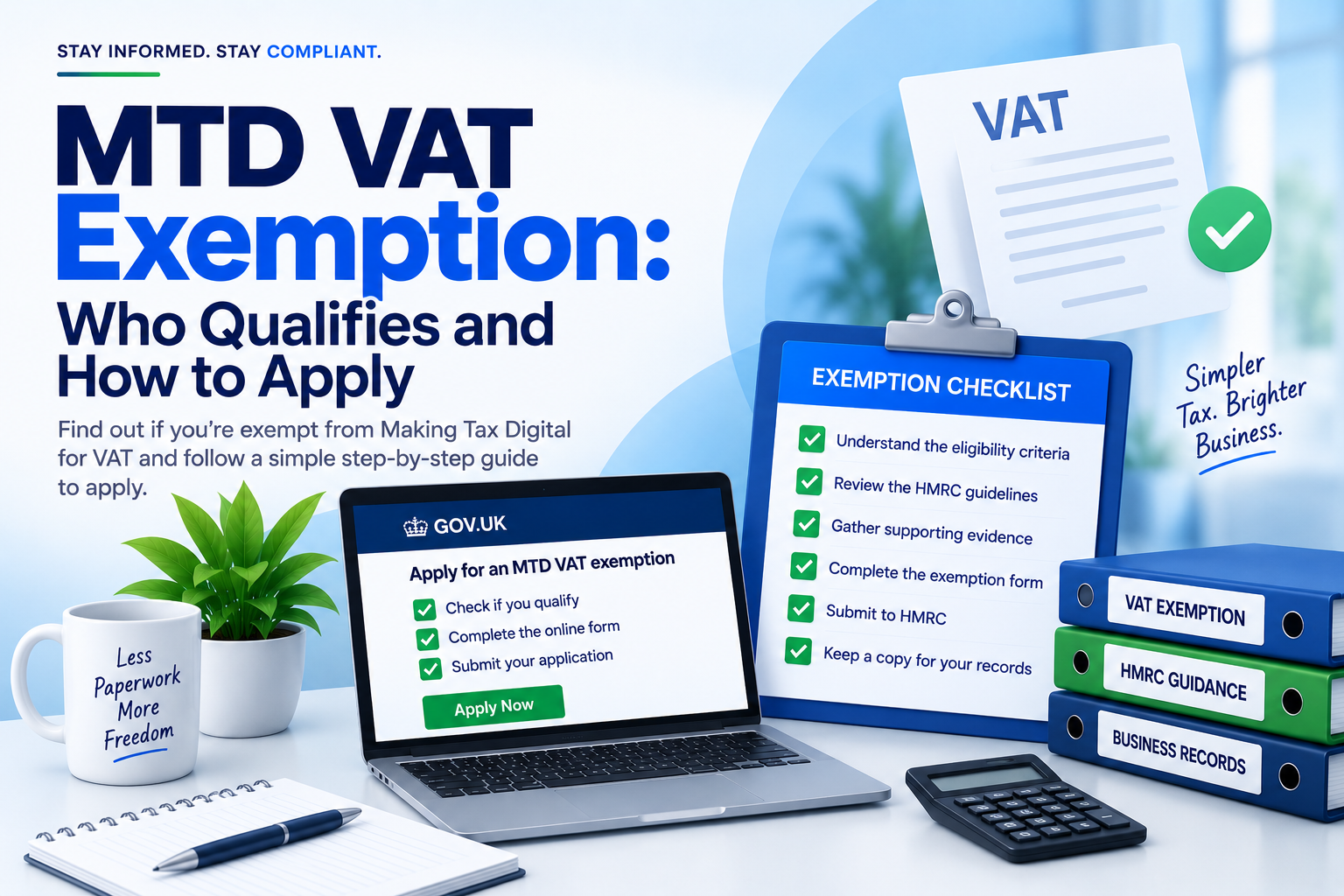
How to Apply for an MTD VAT Exemption
To apply, you contact HMRC directly by phone or in writing through their VAT enquiries service, rather than through an online form.
- Gather your details: your VAT registration number, business name and address.
- Note your current method: how you currently submit your VAT returns.
- Write down your reason: the specific ground you’re applying under.
- Check authorisation: if you’re applying on someone else’s behalf (as an agent or family member), have that authorisation ready.
- Contact HMRC’s VAT enquiries service by phone or in writing with the above.
- Keep filing as normal using your current method while HMRC reviews your application.
What Happens After You Apply
If HMRC approves your exemption, they’ll send you a letter explaining how to submit your VAT returns going forward.
Being upfront: GOV.UK’s published guidance doesn’t set out a specific decision timeframe or a formal appeal process for a refused application. If your application is turned down and you disagree, that’s a point to raise directly with HMRC through the same VAT enquiries service, rather than something this guide can advise on with certainty.
If You’re Not Exempt: What You Need to Do Next
For the large majority of VAT-registered businesses — anyone who isn’t insolvent, isn’t filing a final return, and doesn’t meet one of the specific exemption grounds above — the requirement is straightforward: keep digital VAT records and submit returns using software that’s compatible with Making Tax Digital.
If your records currently live in spreadsheets, you don’t need to abandon that workflow. Bridging software connects an existing spreadsheet to HMRC’s systems so you can keep working the way you already do — see our complete guide to MTD VAT bridging software and Excel-to-HMRC filing for how that works in practice. 11 MTD Bridge is HMRC-recognised bridging software available from £5.99 a return, whether you’re filing your own VAT return or filing on behalf of clients as an agent.
Once you’re set up, our VAT return deadline checklist covers what to review before each submission.
Official HMRC software finder: Find software that’s compatible with Making Tax Digital for VAT
Ready to File with 11 MTD Bridge?
Keep your Excel workflow and file with a UK-focused, spreadsheet-friendly MTD solution.
Start Filing with 11 MTD BridgeFrequently Asked Questions
Do all VAT-registered businesses have to use Making Tax Digital?
Yes. GOV.UK’s guidance states that all VAT-registered businesses should now be signed up for Making Tax Digital for VAT, unless they’re exempt.
Am I automatically exempt from Making Tax Digital for VAT?
Only if you’re subject to an insolvency procedure, or you’ve cancelled your VAT registration and only need to submit a final return. Everyone else needs to apply for an exemption or comply with MTD.
Can I get an MTD VAT exemption because I don’t like using accounting software?
The published grounds for applying are about whether it’s reasonable or practical for you to use computers, software or the internet at all — covering things like age, health, disability, religious belief and lack of internet access. A personal preference for a different way of working isn’t one of the listed grounds.
How do I apply for an MTD VAT exemption?
Contact HMRC by phone or in writing through their VAT enquiries service. You’ll need your VAT registration number, business name and address, your current return method, and the reason for your application.
What happens while HMRC reviews my exemption application?
Keep submitting your VAT returns using your current method until HMRC gets back to you.
What do I need to do if I’m not exempt?
Keep digital VAT records and file using compatible software, such as bridging software if you already work in spreadsheets.
Conclusion
Exemption from Making Tax Digital for VAT is narrow by design — automatic only for insolvency or a final return, and otherwise limited to specific circumstances that make digital filing genuinely impractical. For most VAT-registered businesses, the practical next step is choosing compatible software that fits how you already work, rather than pursuing an exemption that’s unlikely to apply.
If that’s you, see how MTD VAT bridging software works and get set up before your next VAT return is due.